Recently, the research article: “Preserving exposed hydrophilic bumps on multi-bioinspired slippery surface arrays unlocks high-efficiency fog collection and photocatalytic cleaning” was published in "Nature Communications", and Jiangsu University is the first completion institution. Professor Yan Yan and associate professor Dai Jiangdong are co-corresponding authors.
Abstract:
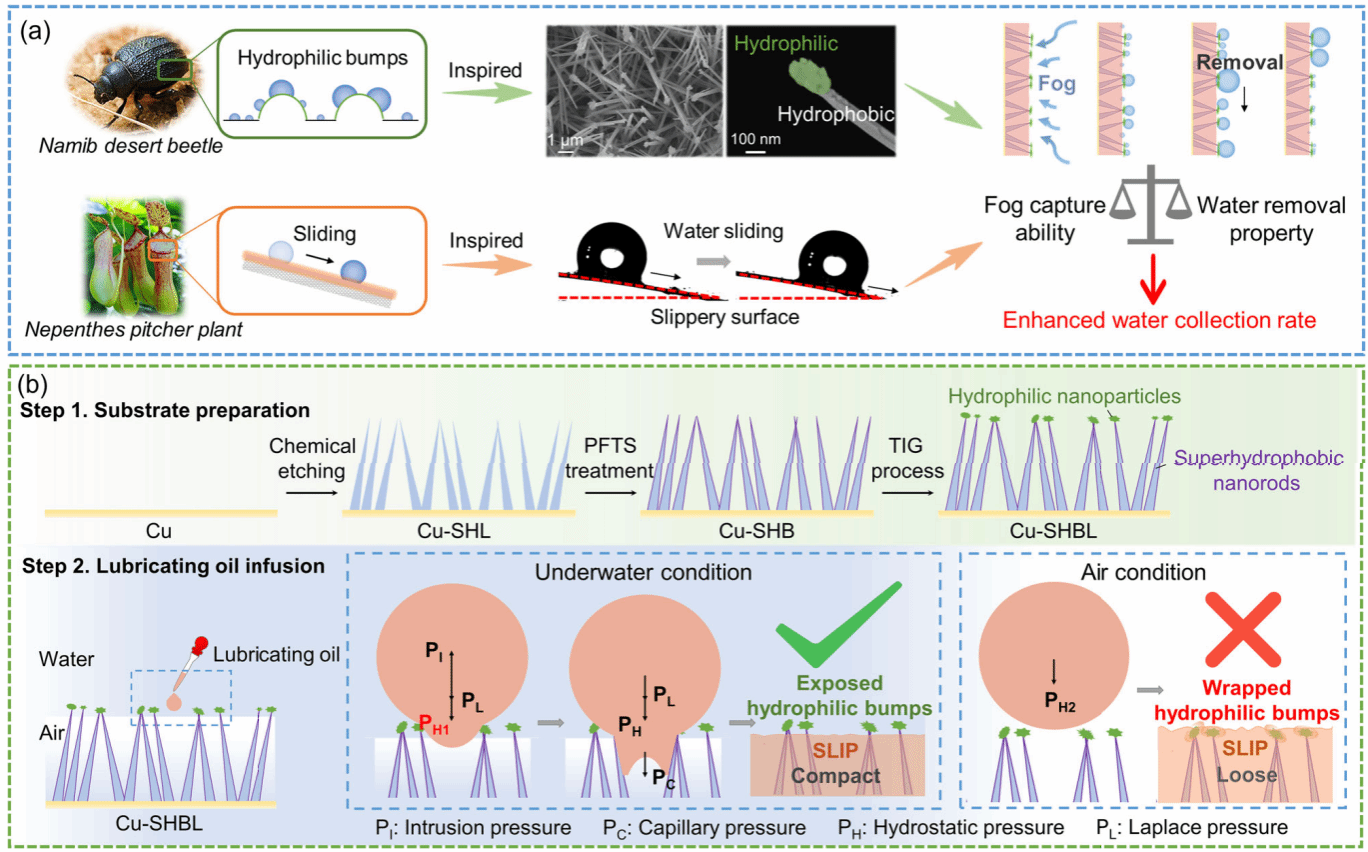
The efficiency of fog collection technologies is inherently hindered by the long-standing dilemma of capture vs. transportation balance. Inspired by nature, we address this issue by preserving hydrophilic bumps on slippery liquid-infused porous surfaces (SLIPS) through an underwater infusion strategy, creating a super-slippery fog collector with multi-scale biomimetic structures. This surface combines features from beetle carapaces and pitcher plant surfaces, enabling rapid initial water capture on hydrophilic bumps and efficient droplet transport. As a result, we develop the most efficient fog-collecting surface reported to date, harvesting 5000-60000 mg/cm² per hour with fog flow rates ranging from 300-1500 mL/h. By macroscopically scaling and optimizing, we construct an integrated 3D fog collecting device capable of harvesting over 660 g of water in 500 minutes. Further integrating TiO2 into the bumps imparts the ability for simultaneous water collection and purification without sacrificing collection efficiency. Our work reveals that resolving the capture-transport dichotomy is key to achieving high-efficiency fog water collection.窗体底端
The Article Link: https://www.nature.com/articles/s41467-025-65169-1